Receivables today. Wait time gone.
If your customers are good for the money but the money takes 30, 60, or 90 days to arrive, factoring turns those invoices into cash now. It’s not a loan — it’s a sale of an asset. No new debt on the books.
What is invoice factoring?
Invoice factoring is the sale of an unpaid commercial invoice to a third party — the factor — at a discount, in exchange for cash now. The factor advances 80–90% of the invoice’s face value, usually within 24 hours, collects from your customer when the invoice comes due, and then releases the remaining reserve to you minus its fee. Because it is the sale of an asset you already own rather than a borrowing, factoring adds no debt to the balance sheet and creates no monthly payment. Approval turns primarily on your customer’s creditworthiness rather than your own, which is why it funds files that unsecured credit declines. Secure Capital Solutions is a broker, not a factor: we place the facility with an independent Lender Partner that funds and services it.
How it works
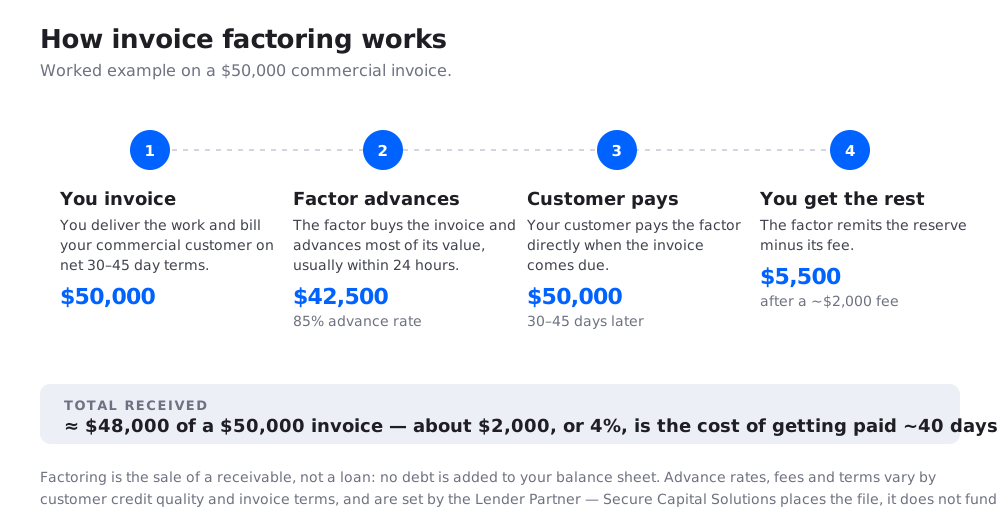
You issue an invoice to a creditworthy commercial customer. Instead of waiting for them to pay, you sell the invoice to the factor. The factor advances 80–90% of the face value to your bank account, typically within 24 hours. When your customer pays the invoice (to the factor, not to you), the factor remits the remaining 10–20% to you, minus a fee.
Factoring can be set up as a one-off (a single big invoice you can’t wait on) or as an ongoing facility (every invoice you issue gets factored automatically as part of normal operations).
When factoring fits
- You sell B2B and your customers are creditworthy. The factor is essentially underwriting your customer’s ability to pay, not yours. Big customers paying late is the perfect use case.
- You’re growing faster than your AR cycle. Every dollar tied up in receivables is a dollar you can’t use to take the next order. Factoring uncouples sales from cash position.
- You’ve been declined for unsecured business credit. Factoring underwrites the receivable, not the operator, so it can fund where term loans wouldn’t.
- Industries with structurally slow AR. Trucking, staffing, manufacturing, wholesale to chain retailers, government contractors.
What it’s not great for
Factoring doesn’t work for B2C businesses (no commercial invoice, no factor). It also doesn’t work for one-time service projects where there’s a single payment with no follow-on relationship. And the cost is rate-of-discount, not APR — it can be cheaper than fast working capital and more expensive than a business HELOC, depending on payment timing. We’ll model it for your specific AR pattern.
How the cost works
Factor fees are quoted as a discount rate per period — commonly something like 2% per 30 days. If your customer pays in 30 days, you keep 98% of the invoice. If they pay in 60 days, you keep 96%. The longer the payment period, the more the factor earns.
Worked example
Illustrative only. Actual advance rates, fees, and reserves are set by the factor based on industry, customer credit, and invoice terms. Formal disclosures provided with any factoring agreement.
What you’ll need to apply
A factor underwrites your receivables ledger, so the document list looks different from a loan application. Most of it comes straight out of your accounting software.
- An accounts receivable aging report. Current, 30, 60, 90+ buckets by customer — the single most important document in the file.
- Sample invoices and the terms you bill on. Net 30, net 60, net 90, and whether you bill on delivery or on milestones.
- A customer list with concentration. Factors care if one account is 60% of your book.
- Three months of business bank statements. Bank-generated PDFs for all operating accounts.
- Basic entity details and owner ID. Legal name, EIN, entity type, and photo ID for each 20%+ owner.
- Any existing UCC filings. A prior lender with a blanket lien on receivables has to subordinate before a factor can fund.